
What does our community need to be healthier?
To answer this all-important question, every three years Sentara Martha Jefferson Hospital joins forces with the Blue Ridge Health District and UVA Health to develop MAPP2Health, a comprehensive community health assessment.
Through hundred of hours of community listening, surveys, and data collection, we build a comprehensive picture of the most pressing health needs for the 266,000 people living in the City of Charlottesville, and Albemarle, Fluvanna, Greene, Louisa, and Nelson counties.
We go directly to residents, community leaders, grassroots nonprofits, and government agencies to understand what people are experiencing, what barriers are standing in their way, and what barriers are standing in their way, and what they believe they need to live a healthier life.
The resulting 2025 MAPP2Health report is a road map for impactful collaboration and data-driven decision making. It will guide Sentara Martha Jefferson Hospital’s priorities, partnerships, and community outreach over the next three years.
While you can read the full report on our website, here we provide a snapshot of what we learned, how it aligns with our previous MAPP2Health priorities, and how our community will work to improve health over the next three years.
While you can read the full report on our website, here we provide a snapshot of what we learned, how it aligns with our previous MAPP2Health priorities, and how our community will work to improve health over the next three years. Heartfelt thanks to the participants and partners who join us every year to create such a powerful tool for improving health here at home for our community.
A Look Back
The MAPP2Health process is a framework for designing a shared vision of success: all residents in our district thriving in supportive environments where structural barriers are limited and everyone has access to the resources and opportunities needed for wellbeing.
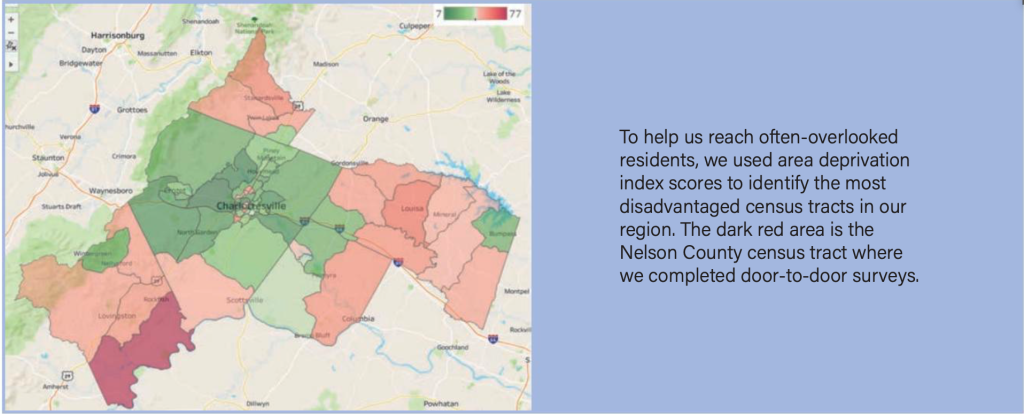
Led by the MAPP2Health Core Group, this year we reached farther into our communities than ever before through more than 700 survey responses, 300+ health planning conversations, and four focus groups. In addition, for this first time, we even went knocking door to door in one of the region’s most isolated, economically disadvantaged census tracts in far southerneastern Nelson County.
We connected with rural residents, low-income families, people living with chronic illnesses and disabilities, and other voices often left out of the decision-making process. We then combined this qualitative data with aggregated and anonymized medical record analysis to provide a broad snapshot of common health trends in our region.
What we heard isn’t surprising: social and economic conditions shape health for our patients long before they step into a healthcare clinic. Challenges like healthy food access, cost of living, and transportation may sit mostly outside our reach as a healthcare organization, but they deeply influence the health and well-being of the people we serve.
Recognizing this reality, since 2016 the MAPP2Health partners have organized around four priorities for healthy communities: improving access to care; promoting healthy eating and active living; addressing mental health and substance abuse; and fostering a healthy and connected community for all ages.
Guided in part by these priorities, Sentara Martha Jefferson has invested heavily to improve access to primary and specialty care in recent years, opening two new medical buildings housing much needed medical care; a new OB-GYN clinic expanding access for all women, regardless of insurance provider, a new urology clinic; and expanded pulmonary care services. A new outpatient endoscopy center will come online in early 2026.
To meet the urgent need for mental health and substance abuse services, Sentara’s investment also made possible the newly opened UVA Pediatric Nuerodevelopmental and Behaviour Health Clinic in Charlottesville.
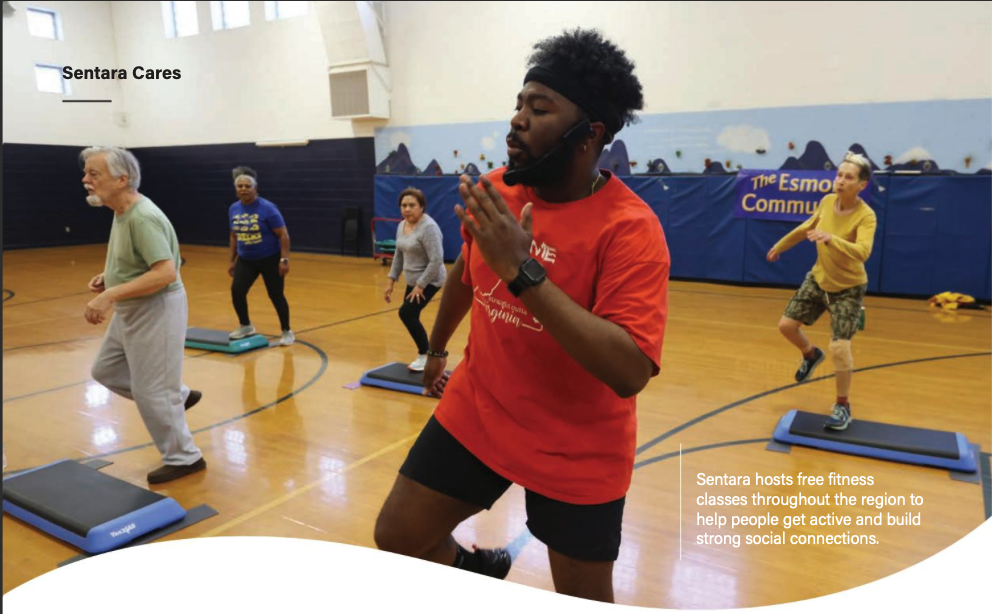
The hospital provides nearly $30 million in uninsured and uncompensated care annually, as well as roughly $400,000 in community health programs, all aimed at helping people access the resources they need to care for themselves and their families. These programs include free chronic disease management classes, health fairs, youth educational programs, and exercise and healthy food distribution events. Many of these programs are funded with community support through the Martha Jefferson Hospital Foundation, demonstrating the power of neighbors stepping up to improve health for all.
2025 MAPP2Health Priorities
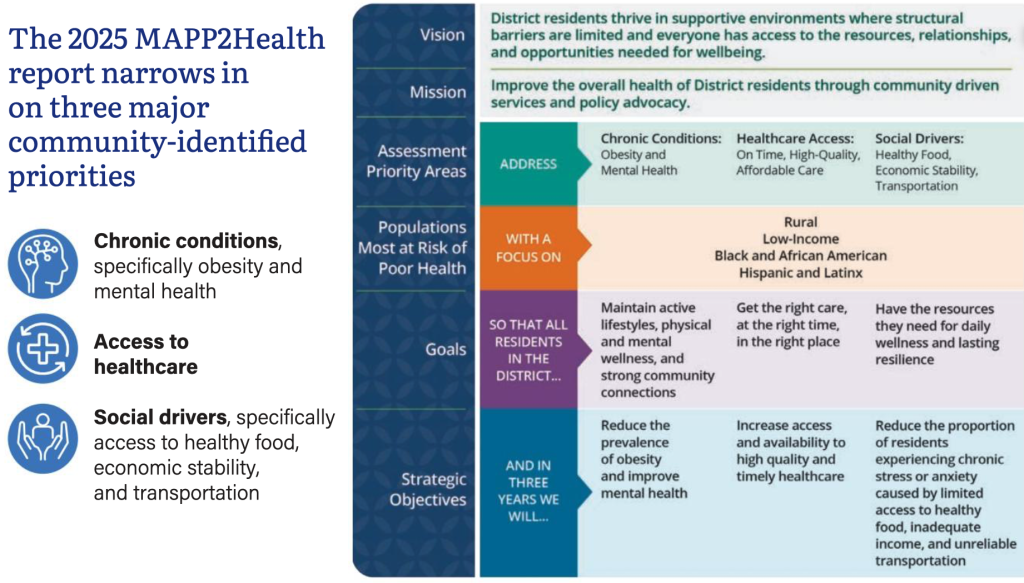
For this year’s report, we tested and refined these priorities to reflect the widespread challenges we saw across geographies, populations, and health systems. These are areas where data and lived experience both point to urgent needs-and significant opportunity for meaningful change.
Priority #1: Chronic Conditions
Across the board, participants ranked obesity, diabetes, high blood pressure and mental health among their top health concerns. Given that obesity often contributes to diabetes and high blood pressure, it was chosen as a strategic point of intervention.
Differences in health outcomes by race were significant: Black patients in the Blue Ridge Health District are 45% more likely to be diagnosed with high blood pressure and 88% more likely to be diagnosed with diabetes than White patients. Rates of tobacco-related illness and respiratory conditions are also substantially higher among Black patients.
Participants struggled to manage their health while grappling with overwork, financial stress, high food costs, and limited access to healthy food options. “It’s an intentional, full-day affair just to get to the closest Food Lion for a lot of folks,” says Nelson-country native Tameka Irving, Sentara Martha Jefferson’s Community Benefits Manager. “Even if someone knows how they’re supposed to eat, the resources just aren’t there to support them.”
When it came to mental health, participants talked about anxiety and depression, and the persistent gap in behavioral health services in our region. But for many participants, the need wasn’t just clinical-they also wanted more shared social spaces. They talked about coffee hours, book groups, walking clubs, and other practical opportunities to relax and connect with their neighbors in everyday ways.
“We’re working to build out wraparound resources, so people have what they need to better their life as a whole person,” says Irving. For example, such as cites Sentara Cares grant funding that paid for lumber and gravel so that local volunteers could build a safe walking trail at the Dunbar School Community Center in Fluvanna.
“I have high blood pressure, but it’s hard to afford the medication.”
Interview Participant
Sentara’s newly opened Community Health and Outreach Center at 920 East High Street aims to provide fully integrated care free of charge, from personalized chronic disease management services, to nutrition and cooking classes, to donated counseling space for The Women’s Initiative to provide free counseling services to the community.
Priority #2: Health Access
While most participants reported having health insurance, many still faced major barriers to care, including long wait times, limited provider availability, and lack of nearby services. Long travel time and difficulty getting appointments were major barriers; one person shared that they traveled over an hour just to see a dentist.
“Given all the challenges, sometimes it’s easier not to go to the doctor, or to minimize until the issue gets really bad,” says Irving.
Participants described months-long delays to see specialists, unreturned calls, and complicated paperwork that blocked access to care. They wanted a system that is easier to access, easier to understand, and built with the needs of patients in mind. While the situation won’t change overnight, Sentara Martha Jefferson is adding new services and providers all the time. Our Bridge Clinic at Fifth Street Station helps patients waiting for primary care services, and our Community Health team travels around the region to dozens of health fairs every year, providing free health checks and guidance connecting with providers.
We also partner with local emergency management services providers, including helping Nelson County establish new paramedicine services to improve access to routine care and reduce costly, non-urgent trips to the emergency department.

Priority #3: Social drivers of health
Community members consistently emphasized that their health depended on more than medical care. The biggest obstacles to well-being weren’t just illness or diagnoses- they were limited income, high food prices, unafforable housing, and unreliable transportation.
Health systems cannot directly lower housing costs or fix public transit; that requires action from legislators and local leaders. But ignoring social drivers of health keeps us treating that effects of poor health, rather than preventing the causes.
“There’s a Dollar General and a gas station- that’s where people get food. That’s all we’ve got.”
Interview Participant
That’s why Sentara Martha Jefferson provides leadership support and grant funding to support safe and affordable housing projects through Habitat for Humanity, healthy food access through the Blue Ridge Area Food Bank, and dozens of other local nonprofits working to address social drivers of health i our community.
Of course, ensuring that all residents have the resources they need for daily wellness and lasting resilience stands far outside the scope of any one organization or health system.
Thankfully, we live and work in a caring community. We remain committed to working in partnership across our region to create a future where everyone has access to the resources and care they need to thrive.

Source: Sentara Martha Jefferson -Fall 2025 Magazine